

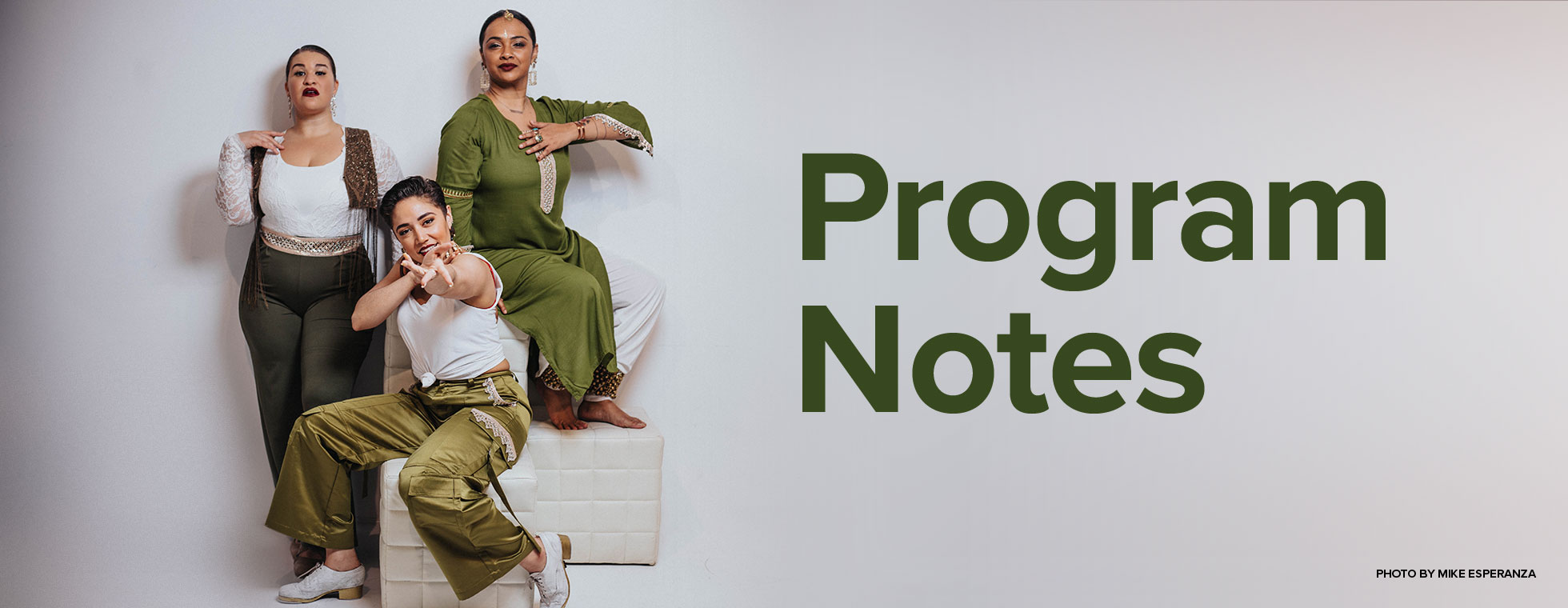
Soles of Duende Program Notes
Table of Contents
Event Details
Acknowledgement of Land
Can We Dance Here?
A Note from the Artists
Soles of Duende
CENTER FOR THE PERFORMING ARTS
presents
Soles of Duende
Can We Dance Here?
7:30 p.m. Wednesday, November 5, 2025
Eisenhower Auditorium
The program runs approximately 75 minutes with a 15-minute intermission.
After the performance, the artists will speak with interested audience members.
Support provided by
Debra Lee Latta and Dr. Stanley E. Latta Endowment
Accessibility services supported by
Sidney and Helen S. Friedman Endowment
A grant from the University Park Fee Board makes Penn State student prices possible.

Acknowledgement of Land
The Penn State University campuses are located on the original homelands of the Erie; Haudenosaunee (Cayuga, Onondaga, Oneida, Mohawk, Seneca, and Tuscarora); Lenape (Delaware Nation, Delaware Tribe, and Stockbridge-Munsee); Shawnee (Absentee, Eastern, and Oklahoma); Susquehannock; and Wahzhazhe (Osage) Nations.
As a land grant institution, we acknowledge and honor the traditional caretakers of these lands and strive to understand and model their responsible stewardship. We also acknowledge the longer history of these lands and our place in that history.
Written by PSU Educational Equity in collaboration with the Indigenous Peoples Student Association and the Indigenous Faculty and Staff Alliance
Why do we make an acknowledgement?
The Center for the Performing Arts at Penn State gathers people together to foster communities, learn from our unique differences, and participate in civic engagement through the arts. We leverage the act of acknowledging the land to spark curiosity and conversation about our nation’s past, present, and future. This ongoing process can change our learning and healing journey as individuals and as a nation, and it is not meant to be resolved. We are not checking a box; we are living in the questions and the possibilities.
Visit Land Acknowledgment for more information.

CAN WE DANCE HERE?
With Can We Dance Here?, three storytellers bask in the light of their third iteration of percussive conversation. Celebrating and elevating their survival amidst the barriers that diminish collective liberation, the Soles of Duende have bottled this synergy into an enticing evening of rhythmic exchange.
Rooted in the freedom their crafts provide them and in dialog with live music, this trio invites the audience to pause, witness, and receive three women of culture boldly taking the floor—here and NOW.
Choreographers and dancers
Amanda Castro, tap
Arielle Rosales, flamenco
Brinda Guha, Kathak
Musicians
Ryan Stanbury, trumpet and musical director
Okai Musik, percussion
A.J. Jagannath, electric guitar
All musical compositions are collaboratively created by and credited to the Soles of Duende collective: Amanda Castro, Arielle Rosales, Brinda Guha, Okai Musik, A.J. Jagannath, and Ryan Stanbury
Ryan Stanbury, musical direction
Raaginder Momi, additional track contributions
Soles of Duende, costumes
Beaudau Banks, technical coordinator
Trevania Layne, production assistant

A NOTE FROM THE ARTISTS
Time has proven that no backstory is linear, continuously revealing how all our histories remain intertwined. From the spice trade to the Middle Passage and transatlantic; from the Nuyo-Rican arrival, to the Immigration and Nationality Act of 1965; from dhabas to bodegas—we embody the histories of our intersectional past, finding our cultures’ rhythms as our collective language.
When it comes to music, what is the one thing we do share? The floor.
From a sixteen-beat teental, underbellied with a twelve-count bulerías, finishing with three and a break, the floor lets us share our cultures across bars. Although a shave and haircut to one is a remate to another and a tehai to the third, we know that when we all arrive, we’ve found our collective musical break.
As percussive artists, we’ve consistently had to ask for permission: permission to create new music, permission to break rules, and permission to even dance on the floor that is built for us to use. Tonight, we offer you ourselves, our history, our music, here and now—in abundance.
So, can we dance here? Si. Yes. হ্যাঁ
Can We Dance Here? premiered at Gibney Spotlight Performances in 2022.
Musical influences for Can We Dance Here?
Various sangeet tukras, drut toras, parans
Kathak gurus Bela Arnab and Malabika Guha
“La Fiesta de Pilito” by El Gran Combo
Escobilla por Bulerías de Cádiz
Letras por Alegrías
“Take the ‘A’ Train” by Billy Strayhorn and Duke Ellington
“Aguanilé” by Willie Colón and Héctor Lavoe
“The Rock Cries Out to Us Today” (excerpt) by Maya Angelou
Each of you a bordered country,
Delicate and strangely made proud,
Yet thrusting perpetually under siege.
Your armed struggles for profit
Have left collars of waste upon
My shore, currents of debris upon my breast.
Yet, today I call you to my riverside,
If you will study war no more.
Come, clad in peace and I will sing the songs
The Creator gave to me when I
And the tree and stone were one.
SOLES OF DUENDE
A Brooklyn-born Puerto-Rican from New Haven, Conn.; a Mexican Puerto-Rican Jew from the Lower East Side, New York; and a Bengali Indian from New Jersey walked on to the wooden floor and the rest? History.
Bonded by their deep love of music, their crafts, and true connection, Soles of Duende is on a lifelong mission to elevate the joy and music of true collaboration across disciplines and the celebration of the forms they practice. Based in the sounds of tap (Amanda Castro), flamenco (Arielle Rosales), and Kathak (Brinda Guha), Soles of Duende’s fire is the spirit that lives within each of these women to celebrate their connection given their beautiful differences and to uplift the forms that made them.

AMANDA CASTRO (tap), featured in Dance Magazine’s “25 to Watch” in 2023, is a “Bessie Award”-winning Puerto Rican-American multidisciplinary artist rooted in rhythm. She was seen in Rhythm is Life by Dormeshia Sumbry Edwards and Chasing Magic by Ayodele Casel. She is a graduate of California Institute of the Arts, where she studied under Glen Eddy of Nederlands Dans Theatre and Andre Tyson from the Ailey Company.
Once a principal dancer of renowned company Urban Bush Women, she’s gone on to star in musical theater productions such as Singing in the Rain in the role of Kathy Seldon; Jared Grimes’ ensemble in 42nd Street; “atomic” performances as Anita in Glimmerglass Festival’s West Side Story (The New York Times); and Lyric Opera of Chicago, among others. Castro has worked for and collaborated on various projects with artists from around the country, including Soles of Duende, Justin Peck, Julio Monge, Caleb Tiecher, Michael Heitz, Jared Grimes, Francesca Zambello. She’s been fortunate to work with innovative artists in the field, and she is constantly on the search to be a part of stories that help elevate our collective humanity.

ARIELLE ROSALES (flamenco) is a “Bessie Award”-nominated performing artist who interweaves the worlds of flamenco, percussion, theater, and improvisation as a means to find connection through duende. She has been dubbed, “excitingly rhythmic and undoubtedly seductive” by Dance Informa Magazine, and “a very intense and wonderful choreographic talent” by BroadwayWorld.com. Her work has been featured on The Today Show (NBC), Good Morning America (ABC), and Mrs. Doubtfire on Broadway.
As an educator, Rosales is a teaching artist with Flamenco Vivo Carlota Santana and New York City Center. She was part of the 2023 cohort of the Hidden Voices project, creating an original flamenco curriculum for the Social Studies Department of the New York City Department of Education. Rosales is a co-founding dancer with the all-women percussive dance trio Soles of Duende, and she is a band member and Conductor with the all-women Afro-Brazilian samba reggae band Batalá New York. Follow @ariellerosales and visit www.ariellerosales.com for more info.

BRINDA GUHA (Kathak) identifies as a non-disabled, caste-privileged, cisgender, and queer South Asian American. She is a “Bessie Award”-nominated artist and trained Kathak dancer of more than twenty years.
Guha trained and performed for years in the Kathak (Malabika Guha) and Manipuri (Kalavati + Bimbavati Devi) dance disciplines, as well as flamenco (Carmen de las Cuevas; Dionisia Garcia) and contemporary fusion vocabularies. She co-founded Kalamandir Dance Company in 2010. She has choreographed for many national stages and self-produced original, feature-length dance productions which earned her artist residencies at Dixon Place (2018) and Dancewave (2019) to continue to develop work.
Guha is represented by CESD Talent Agency and is pursuing artistic direction, performance, and arts education. She trains in Kathak, Manipuri, and contemporary styles, and she is the artistic director and faculty member at Kalamandir of NJ Dance School. Her dream of having art meet activism was realized when she created Wise Fruit NYC, a seasonal live arts installment (established in 2017) dedicated to the feminine divine and honoring select woman-led organizations. For her day job, she works as the senior producing coordinator for Dance/NYC, a service organization based in the values of justice, equity, and inclusion.

RYAN STANBURY (trumpet and musical director), creatively known as “Ryan the Artkitect,” is a Jamaican-American recording artist, arranger, and alchemist from northern New Jersey. Baptized by the vibrations of sweet Reggae music and raised to the tune of Brooklyn block parties and American popular music, Stanbury began his musical journey at the age of 7, first on the violin, followed by the trumpet, and then percussion. He has performed on stages across New York City, the United States, and abroad as a musician and musical director with a vast array of performers.
Stanbury’s musical offerings can be heard throughout an ever-expanding catalog of recorded collaborations as an instrumentalist, composer, producer, and mixing engineer by way of his music production studio, Wilberforce & Annie, a boutique production house founded on amplifying the voices of now.

OKAI MUSIK (percussion), Brooklyn-born with Haitian descent, was beating on anything that he could get his hands onto help his imagination grow from a young age. His ears became infected with the hard boom-bap drum loops of hip-hop, and roots music from the Caribbean. Those sounds led him on a musical path to find rock, jazz, samba, salsa, rumba, and pretty much anything that involves percussion.
Musik has had the pleasure of performing before audiences at Brooklyn Museum, the legendary African art auction exhibition at Sotheby’s, Madison Square Garden, Carnegie Hall, and other venues throughout the United States. Internationally, Cuba, Haiti, Puerto Rico, Canada, Tanzania, Ivory Coast, Australia, Japan, and Brazil have been showered with his sounds, and soon the rest of the world will.

ANDREW “A.J.” JAGANNATH (electric guitar), born and raised in Harrisburg, became infatuated with the guitar at age 13, after a foot injury prevented him from playing sports over one summer. He had many early musical influences to draw from between his mother’s Western classical piano training, his father’s love of music and extensive record collection, and his grandmother’s knowledge and proficiency in singing Carnatic music. Using effects pedals, multiple amplifiers, triggered sounds, and live looping, Jagannath strives to create a rich sonic atmosphere with the guitar that goes beyond the scope of sounds traditionally associated with the instrument.
Jagannath has performed on stages such at Apollo Theater, The John F. Kennedy Center for the Performing Arts, Bowery Ballroom, Brooklyn Bowl, ABC’s The View, and more. He lives in Queens, New York, where he runs a recording studio and works as an engineer.